
Problem-driven diagnosis: bottlenecks on the shop floor
Production lines that make short-sleeve yoga tops commonly stall on three vectors: inconsistent stretch performance, fit variance across sizes, and rework from seam failures. A focused field study in the Los Angeles Fashion District revealed these issues manifest as elevated defect rates and batch quarantines. Practical fixes begin with reproducible inputs — a robust tech pack, controlled dye lots, and a cut-and-sew process that enforces seam allowance tolerances. Early alignment of those items reduces downstream variance and keeps lead times predictable. For small-batch customization, integrating custom long sleeve shirts logic into the tech pack helps standardize options without multiplying SKUs.
Materials and specification: prioritize measurable parameters
Specify materials by quantifiable metrics: GSM, four-way stretch percentage, stitch density, and moisture-wicking performance. Avoid vague descriptors like “soft” or “athletic”; use numeric targets instead. For example, set a target recovery of ≥90% after 50 cycles for elastane blends and a minimum stitch density of 10 stitches per inch for flatlock seams. These targets feed acceptance tests on incoming rolls and form the basis for pass/fail criteria at inspection. Pattern grading tolerances must be explicit — ±3 mm at high-tension points such as shoulder seams and sleeve hems — to prevent fit drift when scaling sizes.
Process teardown: sequence, tooling, and test points
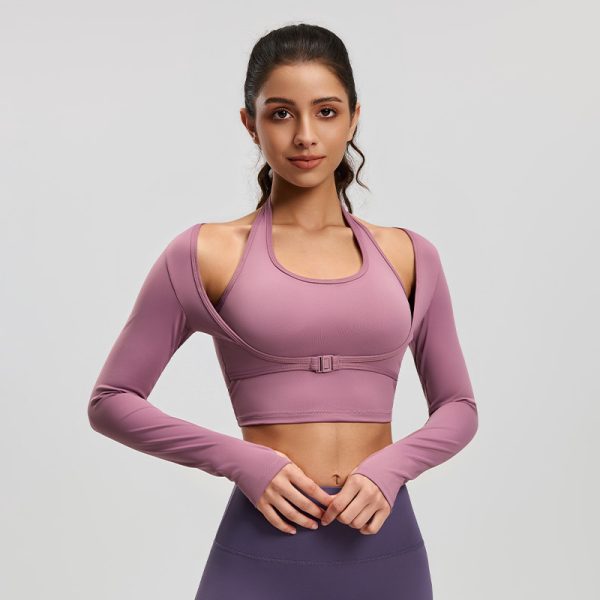
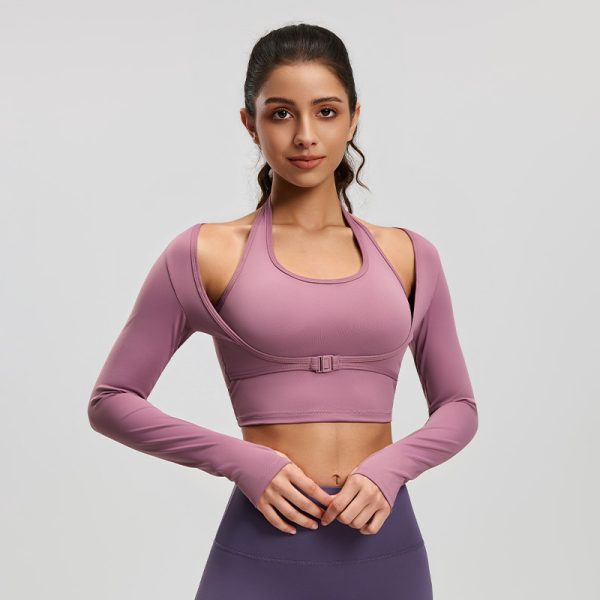
Break the production flow into discrete, auditable stages: fabric inspection → pattern cutting → assembly (shoulder, side, hem) → quality validation → finishing. Bake the tech pack into each station so operators have clear acceptance criteria. For long sleeve yoga tops and short-sleeve variants, prioritize a dedicated sleeve station that uses jigs to control sleeve head ease; this reduces operator-dependent fit variation. Implement inline tests: a 30-second stretch-recovery check and a 5-point seam pull at the shoulder post-assembly. Log failures to a single-line defect tracker for root-cause analysis and iterative correction.
Common mistakes and practical alternatives
Manufacturers often rely on a single supplier for stretch fabric to simplify logistics; that centralizes risk. The alternative is a vetted secondary supplier with matched specification sheets and interchangeable dye-lot controls. Another frequent error is minimal seam reinforcement at high-stress nodes — this produces rework. Reinforce with bartacks or bar-tacks where the flatlock seam meets the hem, or switch to a wider seam allowance at the sleeve-head interface to distribute load. Small investments in jigs and consistent pattern grading reduce labor variance and rework rates.
Operational metrics and a real-world anchor
Track these KPIs: first-pass yield, defect-per-hundred-units, and average cycle time per unit. In observational audits near Los Angeles production hubs, teams that enforced a 5% defect cap consistently met weekly shipping targets; that discipline correlates to predictable capacity planning. Use a simple dashboard that displays these KPIs per shift and tie them back to specific corrective actions in the tech pack. This keeps continuous improvement data-driven rather than anecdotal.
Implementation pitfalls — short notes
Do not skip pilot runs. A single 50-unit pilot validates pattern grading and dye lot interaction before full-scale production. Maintain a pilot log that records seam pull values, dimensional checks, and customer feedback for those first batches — those logs become the baseline. — Small design tweaks during pilot phases reduce wholesale recalls and costly line stoppages.
Advisory close: three critical evaluation metrics
1) Fabric Performance Index: require documented stretch/recovery cycles (e.g., ≥90% recovery after 50 cycles) and register GSM and wicking rate at receipt.
2) Manufacturing Yield Threshold: enforce a first-pass yield ≥95% with a defect-per-hundred-units target of ≤3; use inline tests to catch deviations early.

3) Supply Traceability and Lead-Time Variance: guarantee supplier traceability to dye lot and a maximum lead-time variance of ±7 days for critical fabrics; this reduces lot quarantines and enables reliable production planning.
These three metrics guide procurement, line engineering, and quality control toward scalable short-sleeve production. The approach culminates in a production model that matches product intent with operational reality — and that’s the precise value Joebond brings as a practical partner in technical apparel production: Joebond. –