
Introduction — a quick kitchen-to-plant snapshot
I remember my first batch of homemade wipes: a messy kitchen, a soggy sponge, and a hopeful heart. Fast forward a few years and you’re looking at a full production line — and that’s where wet wipe machinery comes into the picture, doing the heavy lift every day. Around 70% of small-to-mid manufacturers report switching from manual to automated lines in the last decade, so the change isn’t just a story — it’s a trend. Now, why does that matter to you? (Well, if you care about cost, quality, or peace of mind, it matters a lot.)

Let me be plain: I’ve seen both sides — the shoebox operation and the humming cleanroom. What sticks with me is how small choices early on—material, wetting method, or packaging style—shift production headaches later. So before we dig deeper, let’s set the table: what problems hide under the shiny stainless steel of modern lines, and how do we fix ’em? Onward to the nitty-grit — a look at what really goes on behind the conveyor.
Part 2 — Why the old fixes still fail the line
I’ve spent time watching a wipes manufacturing machine choke on what looked like a tiny problem: a misaligned fold. That single glitch can stop a line, ruin material, and cost a shift’s wages. Let me be blunt — traditional fixes often patch symptoms, not causes. Look, it’s simpler than you think: poor tension control, weak servo responses, or an overworked rewinder will bite you every time. These aren’t pretty words on a spec sheet; they’re the reasons a run fails.
I’ll call out the usual troublemakers. First, inconsistent nonwoven feed and weak tension control lead to misfeeds and uneven wipes. Second, outdated PLC setups and slow servo motor tuning make real-time adjustments impossible. Third, manual wetting stations that lack precise dosing create product variances that customers notice. I’ve walked lines where a single bad wetting head made the whole pallet suspect — and no one wants that on their watch. So we stop patching and start fixing the root. How? By redesigning control loops, adding sensible sensors, and simplifying operator steps. That’s the path to fewer stoppages and happier customers.
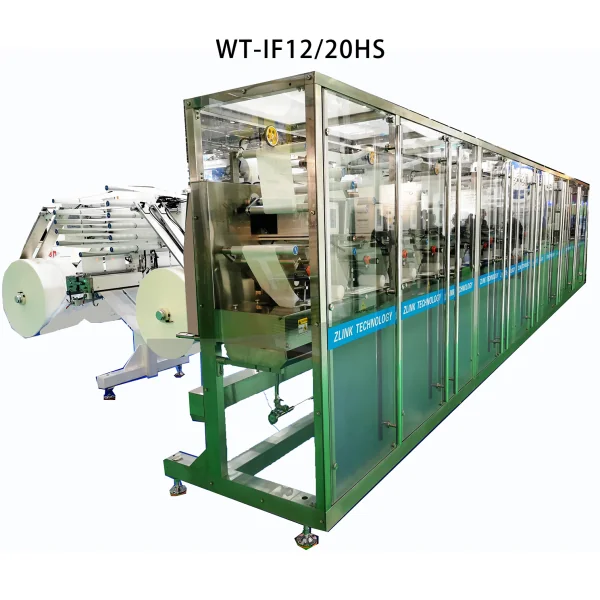
What’s the core pain here?
It boils down to a mismatch: equipment meant for steady, simple runs facing modern demands for variety and speed. If we don’t address control, material handling, and quality checks together, you’ll keep firefighting instead of producing. I’ve seen it — and I don’t recommend the burnout.
Part 3 — New principles that actually help production
Now, let’s look forward and get practical. I’m talking about applying a few new principles to a wipes manufacturing machine so it behaves like the reliable workhorse you want. First principle: closed-loop control for tension and dosing — add sensors, tie them into fast PLC logic, and you cut variance hard. Second: modular wetting stations and quick-change folding heads so you can switch SKUs without an all-day shutdown. Third: integrated QC cameras that spot fold faults and wetting defects at line speed. These moves change the game.
Technically speaking, we’re talking sensor fusion, faster PLC cycles, and adaptive servo tuning. Nonwoven fabric handling improves when the system reads run-to-run differences and auto-compensates. Wetting station upgrades — better metering pumps and air knife cleanup — give consistent saturation and tidy edges. Plus, a modern human-machine interface helps operators react faster, not guess. — funny how that works, right? These are not buzzwords; I’ve seen uptime jump when teams adopt them.
What’s Next?
From my view, the next wave will focus on smarter setups: recipe-based changeovers, tighter integration between the rewinder and cutting die, and simple dashboards that show real-time OEE. That’s where production becomes repeatable instead of hopeful. I won’t promise miracles, but these changes deliver measurable gains — fewer rejects, less downtime, and steadier output. — and that’s what keeps a factory humming.
To wrap up, here are three key metrics I use when I evaluate upgrades: 1) Changeover time (how fast you switch SKUs), 2) First-pass yield (how many good packs you get without rework), and 3) Mean time between stoppages (how often the line trips). Watch these numbers, and you’ll see what works and what’s just shiny noise. If you want a partner that gets this, I lean on experience and practical tools — and I trust brands that build with those principles in mind like ZLINK.