
The problem-driven opening: why fan noise still breaks rooms
When a ceiling fan hums or vibrates it does more than annoy — it erodes perceived quality, distracts occupants, and forces costly retrofits. Facility managers and product teams hear the same brief: “Make it quiet.” The common fix — swapping in a generic fixture — rarely works. A better move is to specify a factory-direct large ceiling fan with light engineered to address root causes: motor cogging, bearing issues, structural resonance, and control-system jitter. Problem-driven design starts with those failure modes and treats acoustic performance as a primary spec rather than an afterthought.

Root causes of motor hum and vibration
Most audible problems trace to a few technical vectors: uneven blade mass (unbalanced moment), imprecise blade pitch, loose mounting hardware, and motor-electronics interactions. On the motor side, legacy AC motors exhibit torque ripple and magnetic cogging; cheap BLDC drives can introduce PWM switching artifacts and microvibrations if commutation isn’t sinusoidal. Mechanical wear — especially in bearing preload and shaft alignment — amplifies low-frequency noise. Add a flexible canopy or poorly isolated joist and you get structural-borne vibration that radiates through drywall and light fixtures.
Why commodity supply chains miss the mark
Cost-driven suppliers optimize for unit price, not acoustic envelope. That means looser tolerances on blade concentricity, economical bearings with higher runout, and controllers prioritized for BOM cost over refined firmware. QA sampling may be statistical rather than 100% dynamic-balance tested, so outliers slip through the line and end up in living rooms or open offices — and the problem looks like bad luck rather than predictable engineering shortfall. For brands and specifiers, those economy trade-offs are precisely where factory-direct partners can differentiate.
Factory-direct engineering levers that eliminate hum
Factory-direct manufacturers that target silent operation apply a systems approach across hardware, firmware, and assembly processes. Key levers include:
– Motor topology: skewed laminations or trapezoidal rotor designs reduce cogging; BLDCs with sinusoidal commutation minimize torque ripple. – Bearing strategy: preloaded sealed ball bearings (controlled axial play) and higher precision (ABEC-grade) reduce wobble and extend life. – Dynamic balancing: CNC jigging and spin-balanced blades at production eliminate eccentric mass. – Structural isolation: engineered rubber grommets, tuned canopy mounts, and stiffer hubs decouple airborne from structure-borne vibration. – Control firmware: PWM smoothing, ramp profiles, and closed-loop speed control with current sensing remove micro-jitter and audible switching harmonics.
Pair those engineering controls with 100% end-of-line acoustic verification and you get measurable reductions in A-weighted dB — the same metric acoustic engineers reference in WHO and ASHRAE guidance for occupant comfort. In practical projects (open-plan offices and classrooms), switching to purpose-built units eliminated most complaints without ceiling reinforcement — a win for retrofit budgets.
Design-to-install checklist for avoiding surprises
Specify these items up front to avoid post-install noise remediation: – Explicit acoustic spec (max dBA at 1 m and at mounting surface). – Tolerance table for blade mass and pitch; require dynamic-balance certificates. – Motor electrical spec: specify sinusoidal BLDC or VFD profile if using induction. – Mounting hardware and canopy isolation details; require torque specs for install. – Firmware behavior: soft-start/stop, speed hysteresis limits, and remote-control communication latency limits.

Also confirm on-site compatibility with your dimmers and smart controls — mismatched triac dimmers or legacy wall modules can introduce buzzing. Test with the actual control stack, not a lab bench sample — install environment alters the acoustic outcome.
Common mistakes teams still make — and the quick fixes
1) Relying on SKU pictures for balance: insist on balance certificates. 2) Specifying speed steps without smoothing: require soft acceleration profiles in firmware. 3) Underestimating canopy resonance: use isolation pads or change mounting plate geometry. These are simple to catch in procurement if your RFQ includes dynamic-balance, bearing-grade, and control-firmware requirements — and if you ask for a run-in acoustic sample before full production.
Where stylish design meets engineered silence
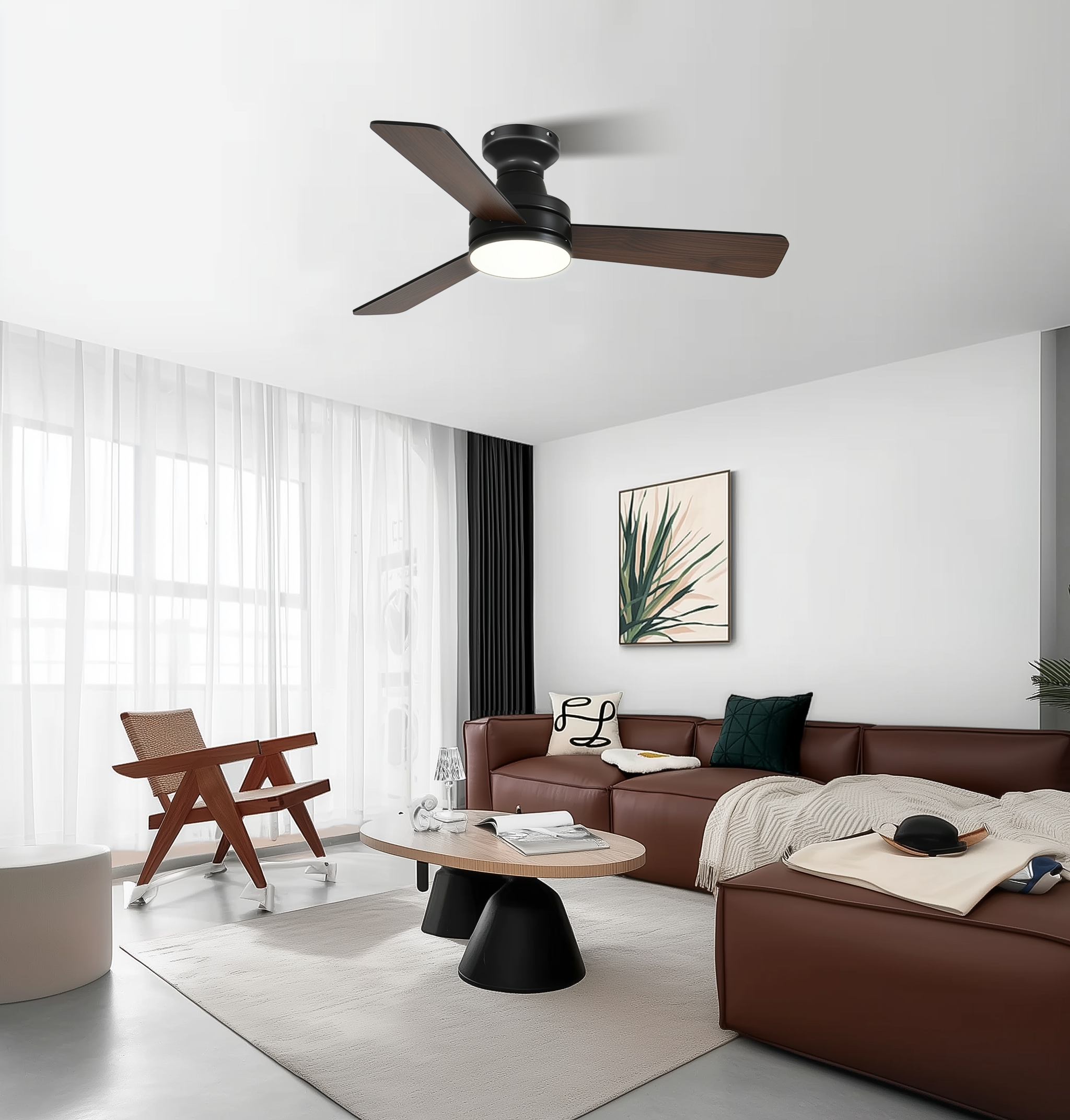
Stylish fans can be quiet — provided their aesthetic choices don’t compromise stiffness or balance. Thin blades look modern but must be aero-shaped and precision-cut to avoid flutter. Integrated lighting (LED modules) needs isolated mounting so the luminaire doesn’t act as a sounding board. If you want both form and function, evaluate factory-direct models of big ceiling fans with lights that publish acoustic metrics and include firmware release notes — that transparency separates engineered products from decorative ones.
Real-world anchor and validation
Noise guidelines from institutions like the World Health Organization and HVAC standards bodies underscore the importance of managing indoor sound levels — they’re not theoretical. Project teams in urban retrofit programs (e.g., Bay Area office refurbishments) routinely shortlist fans with verified dB ratings and firmware controls because occupant comfort measurably improves post-install — fewer complaints, less rework, and better energy profiles when fans pair with HVAC setpoints.
Advisory: three critical evaluation metrics
1) Acoustic performance: require a stated A-weighted dBA at 1 m and at the mounting surface; treat this as non-negotiable. 2) Mechanical tolerance and balance: demand dynamic-balance certificates plus bearing-grade specifications (preload and runout numbers). 3) Control fidelity: inspect firmware behavior — soft-start profiles, sinusoidal commutation for BLDCs, and documented anti-jitter algorithms.
Apply those three checks during procurement and you’ll convert subjective “quiet” into quantifiable specs that suppliers must meet.
For projects that need silent, stylish airflow engineered end-to-end, factory-direct solutions that combine mechanical precision and control firmware avoid the typical trade-offs — and that’s exactly the value teams find when they move from commodity fixtures to engineered offerings from partners like Orison. —